Compare total cost
Use the all-in model to compare treatment, travel, and follow-up responsibilities.
If you are researching veneers in Costa Rica, begin with the treatment plan rather than a destination ranking. Two quotes can use the word veneers while describing different restorations, materials, tooth counts, laboratories, clinical steps, and aftercare.
The useful question is not simply, "What do veneers cost in Costa Rica?" It is, "What exactly would I receive, who would be responsible for it, and what happens after I return home?"

Start by asking what each treated tooth will receive. The American Dental Association's veneer guide explains that a veneer covers the front surface of a tooth, while a crown covers the tooth rather than only its front. Composite bonding applies tooth-colored resin to reshape or repair a tooth. When resin covers the visible front surface, it may be described as a composite veneer. The amount of tooth structure treated and the appropriate restoration remain case-specific, so a dentist must make that decision. Then name the material class.
For every quote, write down:
These details turn the word veneer into a plan you can actually evaluate.
Porcelain is a broad ceramic category, not one product. Emax, zirconia, and feldspathic porcelain have different properties and laboratory workflows. Composite veneers use tooth-colored resin rather than ceramic.
No material name guarantees a particular appearance or outcome. The dentist still has to decide whether a material fits the teeth, bite, bonding conditions, appearance goals, and proposed treatment. The laboratory and design process also matter because shape, proportion, shade, surface texture, and edge character influence how a finished smile is perceived.
Use the Emax veneer guide to understand one named ceramic option, then ask the clinic to document the exact material in your own plan.
Comparing veneer prices in Colombia requires more than a country label or headline number. First identify whether the proposed restoration uses composite resin or porcelain or ceramic. For a ceramic plan, distinguish a named material such as Emax from an unbranded ceramic tier. Then identify the lab by name and location and confirm the aftercare path for polishing, adjustments, repairs, or remakes after you return home, including whether travel may be required. This is market-level comparison guidance, not a Colombia Smile Studio price quote. Use the all-in cost model to compare like with like.
Apply that same discipline to any Costa Rica quote. Then add the trip costs and responsibilities that sit outside the treatment total, which may include flights, lodging, local transportation, meals, time away, schedule changes, follow-up at home, or return travel if required.
Do not treat an advertised package as complete until the inclusions and exclusions are in writing. A lower total may still represent good value, but only a like-for-like comparison can show that.

A country name alone does not establish the quality or safety of any individual treatment plan. What decides that is the treatment itself: the restoration and material class (composite resin vs porcelain; Emax vs unbranded ceramic), the lab and where it is, the treating dentist's credentials, the aftercare and adjustment path once you are home, and the written warranty or remake policy. Weigh those against the quote, not headline price alone.
Apply the same verification standard to every clinic and every destination. Ask for names, roles, documents, and written policies you can review before booking. Do not substitute a country reputation, social following, package label, or material logo for the individual clinical plan.

Veneers change the visible design of a smile. Before treatment, ask how the proposed shape, shade, tooth count, and proportions will be reviewed. Ask what happens if the preview does not match what you expected and at what point a decision becomes irreversible.
A useful design conversation should make your preferences specific. Do you want a subtle change or a brighter result? Which teeth show when you speak and smile? How should the new teeth relate to the surrounding teeth and your face? The goal is to design the smile first and choose veneers around it, so the finished direction can still look like you.
Distance changes follow-up logistics. Before travel, ask who will answer questions after treatment, what records you will receive, whether a dentist at home may participate, and how the treating clinic handles polishing, bite adjustments, repairs, or remakes.
Read any written warranty or remake policy in full. Confirm eligibility, exclusions, patient responsibilities, payment responsibilities, and circumstances that could require another trip. A policy is useful because it makes responsibilities visible. It is not a guarantee of a particular clinical result.
For the broader medical-tourism decision, read Are Veneers Abroad Worth It?.
A Costa Rica veneer plan deserves consideration when it is clinically appropriate for you and clear enough to compare. Before deciding, you should be able to identify the restoration, material, dentist, laboratory, design process, included care, exclusions, follow-up path, written terms, and total trip responsibilities.
If important details remain unnamed, the quote is not ready for a meaningful comparison. Ask for the missing information first. Then compare the complete Costa Rica plan with the complete alternatives, including the veneers in Colombia framework, on value rather than headline price.
This page is for education only and does not replace an individual dental examination. Read the Terms and Medical Disclaimer.
They may be worth considering when a dentist determines that veneers are appropriate for your teeth and the written plan identifies the restoration, material, treating dentist, laboratory, tooth count, design process, aftercare, and total trip responsibilities. The destination name alone cannot establish the quality, safety, or value of an individual plan.
There is no single useful figure without the treatment details. First identify whether the quote describes composite resin or ceramic veneers, the named material or tier, the exact tooth count, the laboratory, included clinical steps, and aftercare. Then add travel and possible follow-up costs. Compare complete written plans rather than one advertised total.
Ask for the treating dentist and role, the restoration proposed for each tooth, the material class and any ceramic brand or tier, the laboratory name and location, the design and approval steps, the tooth count and written inclusions and exclusions, the aftercare path, and any repair or remake terms. Those details, not the destination name, tell you whether a Costa Rica plan is ready to evaluate.
The material decision is case-specific. Ask the dentist to explain why the proposed composite resin or ceramic fits your teeth, bite, bonding conditions, and appearance goals. For any ceramic plan, ask for the exact brand or tier and laboratory rather than accepting porcelain as a complete description.
Verify the treating dentist and role, the restoration for each tooth, material, laboratory, design and approval steps, treatment schedule, inclusions, exclusions, aftercare contact, written repair or remake terms, and any circumstances that could require care at home or return travel.
Use the all-in model to compare treatment, travel, and follow-up responsibilities.
Review the Colombia treatment and trip planning framework.
Separate the destination decision from the procedure decision.
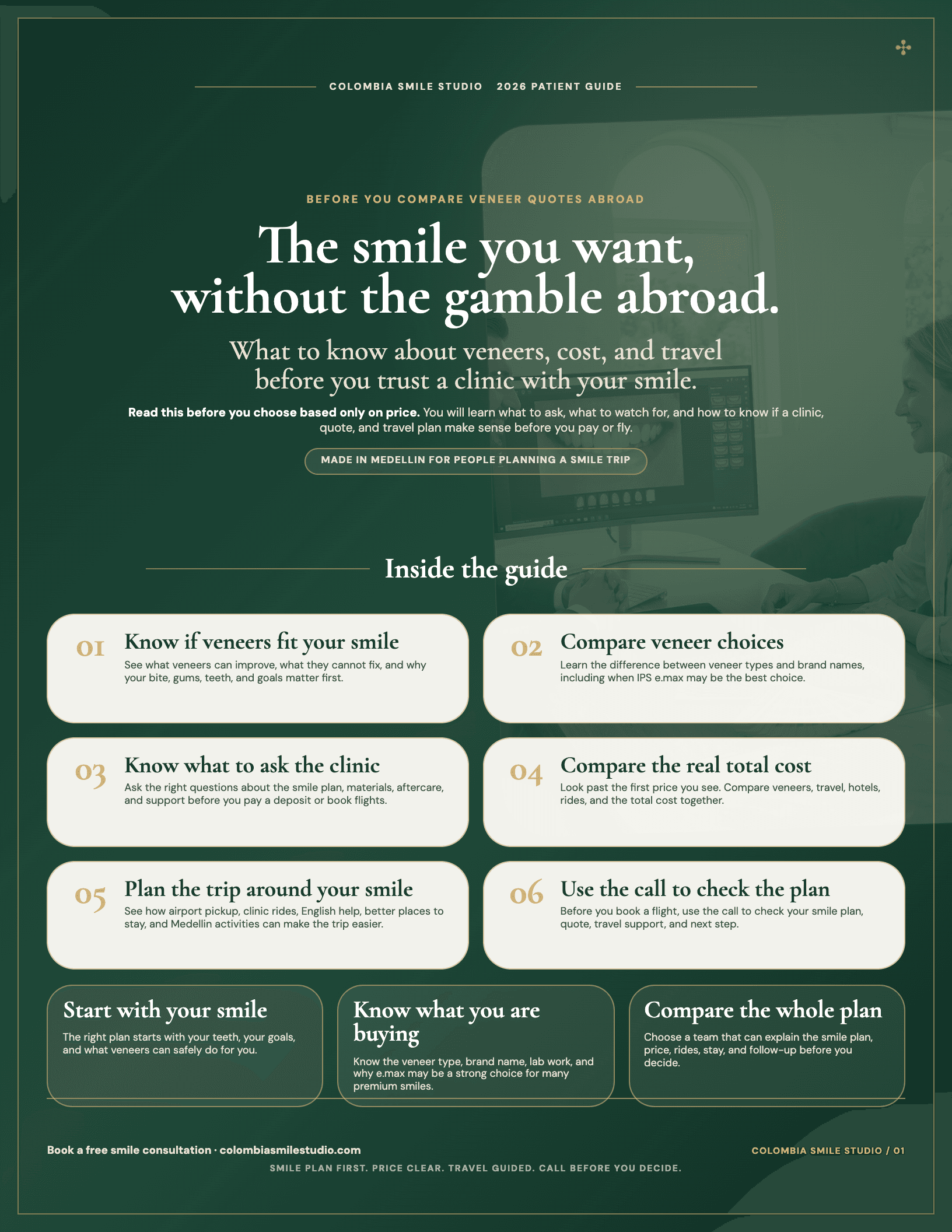
Get the free Veneers Abroad Guide and see the full picture: real costs, clinic-standard questions, and what to ask before you ever book a flight.
© 2026 Colombia Smile Studio. All rights reserved.
Colombia Smile Studio is owned and operated by American Health Group S.A.S.