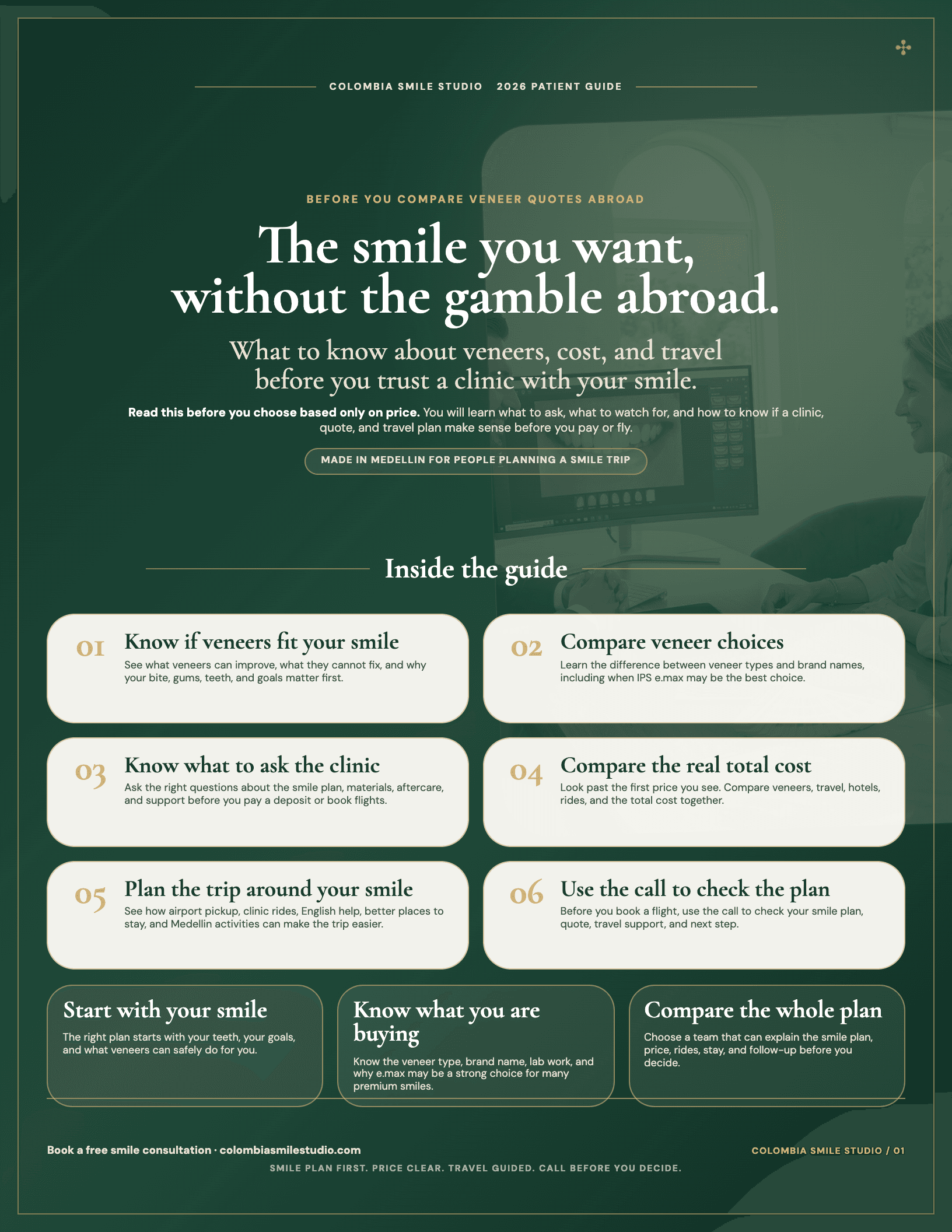
Your dream smile abroad + private Medellin conciergeFree Veneers Abroad Guide for U.S. patients
Porcelain veneer guide
Porcelain Veneers: Types, Cost, and How to Choose the Right One
Porcelain is not one single veneer product. Emax and feldspathic veneers both sit inside the porcelain category, but they are made differently and solve different design problems. The useful question is not simply whether porcelain is good. It is which restoration, material tier, lab workflow, and aftercare plan fit the smile being designed and the teeth supporting it.
Educational guidance only. A dentist must determine the restoration and material after an individual examination.
Start with the restoration
What porcelain veneers are
Porcelain veneers are lab-made ceramic restorations designed for the visible front surface of selected teeth.
They may be used to change visible shade, shape, proportion, edge detail, or symmetry, but the planned result and the amount of tooth preparation remain case-specific.
Start by asking what each treated tooth will receive. The American Dental Association's veneer guide explains that a veneer covers the front surface of a tooth, while a crown covers the tooth rather than only its front. Composite bonding applies tooth-colored resin to reshape or repair a tooth. When resin covers the visible front surface, it may be described as a composite veneer. The amount of tooth structure treated and the appropriate restoration remain case-specific, so a dentist must make that decision. Then name the material class.
Lithium disilicate
Emax is lithium disilicate porcelain
Emax veneers are made from lithium disilicate glass-ceramic. The material can be pressed or milled outside the mouth, then bonded as part of a dentist-led treatment plan. It is often discussed when the design calls for a balance of ceramic strength, translucency, and detailed lab finishing. The Emax page owns the subtype-specific evidence, verification questions, and decision detail.
Hand layered
Feldspathic is hand-layered porcelain
Feldspathic veneers use a traditional porcelain that a ceramist builds in layers. That workflow can give the ceramist detailed control over translucency, surface texture, value, and edge character. It is a specialist option whose fit depends on the underlying shade, enamel, bite, planned change, and lab skill. The feldspathic page owns those subtype questions.
Resin comparison
Composite is not porcelain
Composite veneers use tooth-colored resin rather than porcelain. Resin can be placed directly or made indirectly, and it is generally more prone to staining and surface wear than ceramic.
Ceramic comparison
Zirconia is a separate ceramic family
Zirconia veneers use zirconium-oxide ceramic. Zirconia is known for strength, while opacity and masking vary by formulation and thickness. It belongs in the material comparison, but it is not an Emax or feldspathic porcelain subtype.
Smile zone planning
Why porcelain is often discussed for front teeth
Front teeth make shade, translucency, shape, edge detail, and symmetry highly visible. Porcelain gives the dentist and lab a ceramic surface that can be planned around those features. That does not make it automatically right for every front tooth.
A dentist still needs to review:
The condition of the tooth and any existing restoration
The amount and quality of enamel available for bonding
Bite forces, clenching, grinding, and edge-to-edge contact
The shade that must be preserved, changed, or masked
The size and direction of the planned shape change
How the proposed veneers will sit beside untreated teeth
The maintenance and aftercare path once treatment is complete
The design should lead to the material. A material name should not be used as a default for every smile.
Surface and shade
Do porcelain veneers stain?
Glazed porcelain generally resists external staining better than composite resin, but it is not accurate to call any veneer stain-proof. Surface condition, polishing, oral hygiene, smoking, food and drink habits, and the margins where porcelain meets natural tooth structure can all affect how the smile looks over time.
If a porcelain surface becomes rough, damaged, or altered, it may collect discoloration differently than an intact polished surface. Natural teeth beside the veneers can also change shade, which may affect the overall match even when the porcelain itself remains stable. A dentist should examine any visible change rather than treating it as a material-only question.
Proof with context
What porcelain veneer before-and-after photos can tell you
Porcelain veneer before-and-after photos can help you inspect shade direction, tooth proportions, edge shape, symmetry, and how the smile relates to the face. They cannot predict what your own result will be.
Use a case only when it is the same patient, the treatment episode is verified to include veneers, the material and tooth count are confirmed, and the images use honest crops and editing. Mixed cases must name every restoration. A single photo pair should never be treated as a candidacy decision, an outcome promise, or proof that one material is universally better.
No patient case or image is supplied with this page. The page launches without a gallery rather than use a placeholder, generated result, competitor image, or unverified pair.
Cost without shortcuts
How much do porcelain veneers cost?
Porcelain veneer cost changes with the restoration and material tier, tooth count, lab, design and preparation needs, inclusions, aftercare, and whether the comparison is per tooth, full set, or all-in with travel. This category page explains those drivers without repeating the detailed country tables owned by the all-in veneer cost guide.
Comparing veneer prices in Colombia requires more than a country label or headline number. First identify whether the proposed restoration uses composite resin or porcelain or ceramic. For a ceramic plan, distinguish a named material such as Emax from an unbranded ceramic tier. Then identify the lab by name and location and confirm the aftercare path for polishing, adjustments, repairs, or remakes after you return home, including whether travel may be required. This is market-level comparison guidance, not a Colombia Smile Studio price quote. Use the all-in cost model to compare like with like.
Verification first
How to compare a porcelain veneer dentist and plan
The material label is only one part of the decision. A useful comparison names the proposed restoration, the ceramic tier, the dentist responsible for the plan and bonding, the lab and its location, the review process for shape and shade, and the written aftercare or remake path.
A country name alone does not establish the quality or safety of any individual treatment plan. What decides that is the treatment itself: the restoration and material class (composite resin vs porcelain; Emax vs unbranded ceramic), the lab and where it is, the treating dentist's credentials, the aftercare and adjustment path once you are home, and the written warranty or remake policy. Weigh those against the quote, not headline price alone.
Questions to take into a clinic comparison:
Is each proposed restoration a veneer, crown, or composite bonding?
Which porcelain subtype is planned, and could it change after the examination?
Which dentist designs, prepares, tries in, and bonds the case?
Which lab makes the veneers, and where is it located?
How will shade, shape, translucency, and edge detail be reviewed before final bonding?
What happens if polishing, an adjustment, a repair, or a remake is needed after returning home?
Glazed porcelain generally resists external staining better than composite resin, but it is not stain-proof. Surface condition, polishing, hygiene, smoking, food and drink habits, and the natural-tooth margins around a veneer can affect appearance over time. A dentist should examine a visible color change before deciding whether it is surface stain, a margin issue, or a neighboring-tooth mismatch.
Are porcelain veneers good for front teeth?
Porcelain is often discussed for front teeth because ceramic shade, translucency, shape, texture, and edge detail can be planned together. Suitability remains case-specific. A dentist must review enamel, underlying shade, existing restorations, bite forces, tooth position, and the size of the proposed change before recommending porcelain for any front tooth.
What affects porcelain veneer longevity?
Material subtype, lab work, bonding, bite, home care, and follow-up can all affect porcelain veneer longevity. One lifespan cannot predict an individual result. Read how long veneers last for the sourced material-by-material evidence rather than using a generic year range here.
How much do porcelain veneers cost?
Cost depends on the porcelain subtype, tooth count, lab, design and preparation needs, inclusions, aftercare, and whether the comparison is per tooth, full set, or all-in with travel. Use the all-in veneer cost guide for the detailed model. A headline price is useful only when the treatment behind it is comparable.
Next step
Want a clearer way to compare materials, clinics, travel planning, and aftercare before you decide?